 English
 Deutsch
 Polski
 Français
 Română
 czeski
 Español
 Italiano
Valley Temple of Khafre

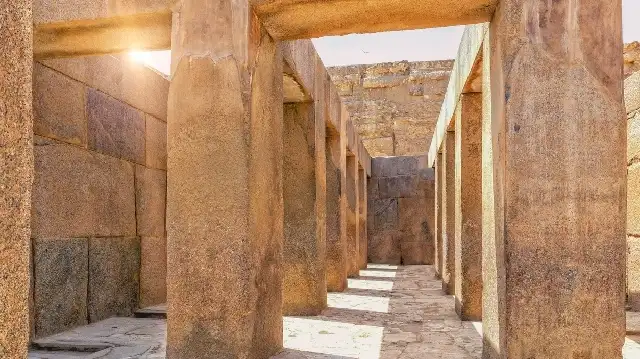
The Valley Temple of Khafre is one of the most impressive and best-preserved Ancient Egyptian temples, standing proudly on the Giza Plateau beside the legendary Great Sphinx. Blending extraordinary craftsmanship with deep spiritual symbolism, this temple offers visitors a rare opportunity to step inside a structure that has remained almost intact for over 4,500 years.
As part of Khafre’s grand funerary complex—alongside his pyramid, mortuary temple, causeway, and the Sphinx—this remarkable site continues to be a major highlight for travelers exploring Cairo attractions or anyone seeking a closer look at ancient Egyptian engineering, ritual practices, and cosmic design.
What Is the Valley Temple of Khafre?
The Valley Temple of Khafre, often called the Giza Valley Temple or Khafre Temple, dates back to around 2570 BCE during Egypt’s 4th Dynasty. The temple once served as the starting point for the pharaoh’s journey into the afterlife, acting as a ceremonial gateway where key rituals were performed before the king’s body was transported to the pyramid for final burial.
What makes this temple extraordinary is not only its religious significance but also how exceptionally well it has survived. Built with massive limestone blocks and clad in polished granite, the Valley Temple remains one of the most intact structures in all of ancient Egypt.
Where Is the Valley Temple of Khafre Located?
The temple sits on the eastern side of the Giza Plateau, just a few steps away from the Great Sphinx and connected directly to the Pyramid of Khafre by a long, covered causeway.
Location within the Giza Pyramid Complex
- The Valley Temple marks the lowest point of Khafre’s funerary complex.
- It links directly to the Mortuary Temple near the pyramid via a paved causeway.
- The site is roughly 30 minutes from Downtown Cairo, making it easy to reach for local and international visitors.
Connection to the Great Sphinx
One of the most fascinating features of the Valley Temple is its tight connection to the Great Sphinx. Only a few meters separate the two structures, and both align with the same ceremonial causeway.
The Sphinx’s position—gazing east toward the rising sun—mirrors the temple’s cosmic orientation, hinting at a shared spiritual purpose.
Connection to the Ancient Nile
In ancient times, the Nile’s floodwaters reached the base of the Valley Temple.
This allowed boats to transport the pharaoh’s body from Memphis directly to the temple for purification rituals, making the site both symbolically and practically essential.
Why This Site Was Chosen
Khafre’s architects selected this location with precision:
- Easy access via the Nile for royal funerary processions
- Perfect alignment with the Sphinx, the sun, and celestial bodies
- A limestone hill remaining from quarrying works provided the base for sculpting the Sphinx itself
The result was a unified architectural and spiritual landscape unlike any other.
Why the Valley Temple of Khafre Was Built
As with many Ancient Egyptian temples, the Valley Temple served both practical and sacred functions. It was the pharaoh’s gateway into eternity.
Role in the Funerary Process
The temple was the first station in Khafre’s funerary journey. Upon arrival:
- Priests welcomed the body and began preliminary embalming.
- Purification rituals used oils, incense, and resins believed to hold spiritual power.
- Rituals prepared the king for his transformation into a divine being.
From here, the body traveled along the causeway to the Mortuary Temple beside the pyramid.
The “Opening of the Mouth” Ceremony
One of the most important rituals performed in the Valley Temple Giza was the Opening of the Mouth.
This ceremony restored the senses of the deceased pharaoh—sight, speech, breath—ensuring he could function in the afterlife.
Priests used specialized tools, symbolic incantations, and precise gestures to “awaken” the king spiritually.
Beliefs About the Afterlife
Ancient Egyptians believed the soul required:
- Purification
- Reanimation
- Guidance to pass safely through the underworld (duat)
The Valley Temple was designed to support this spiritual transformation and symbolize the pharaoh’s rising again with the sun god Ra.